Home → The Series → Series Nº 66
Series Nº 66 · Lares
Twenty-five plates of one household — Leo, an orange Maine Coon; Tigris, a brown mackerel tabby; and Custos, a Great Pyrenees — the inheritance, the pattern and the eye, the mechanics, the warmth, and the household they share
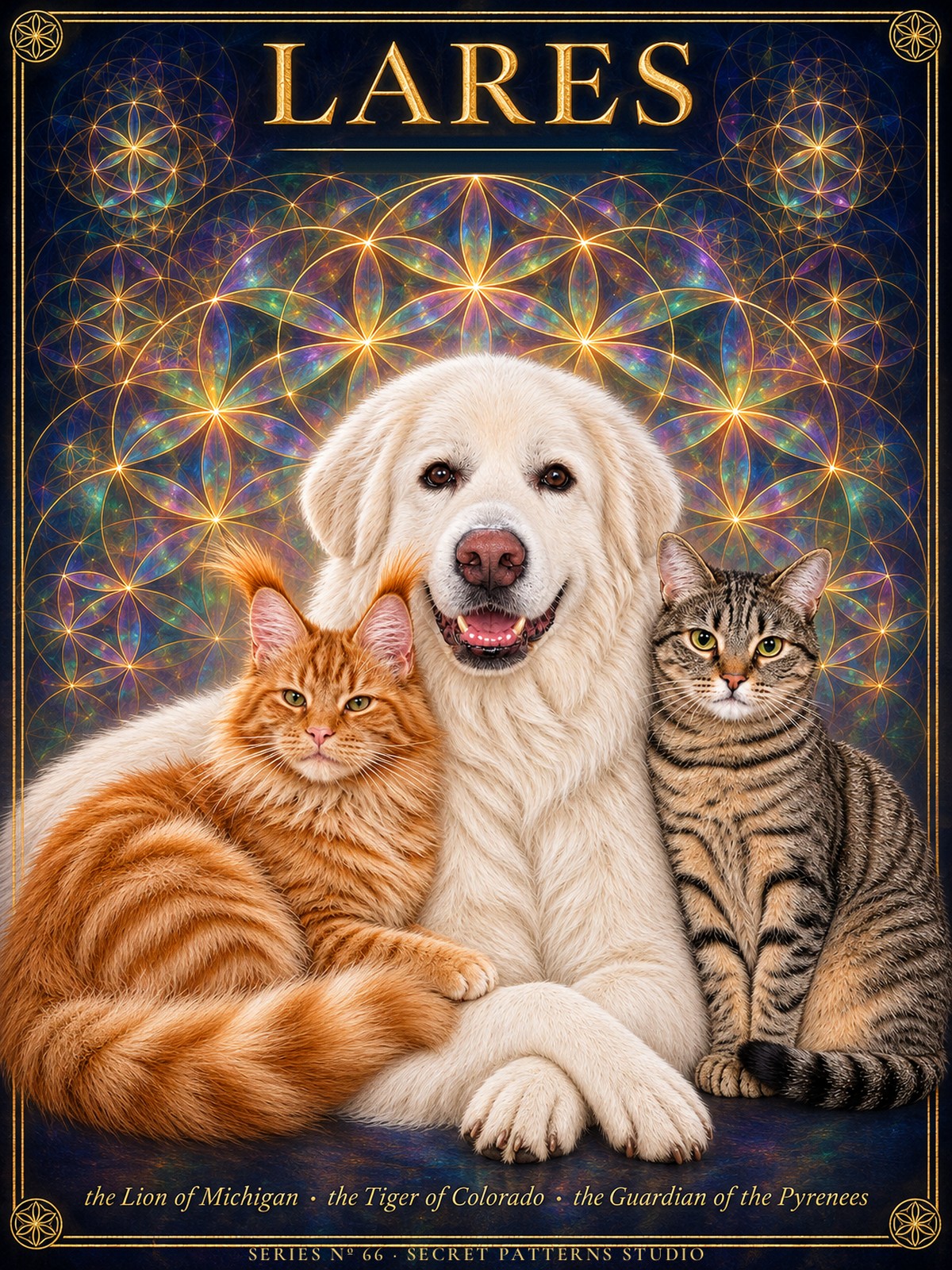
The household in motion — Leo, Tigris and Custos, drawn and alive.
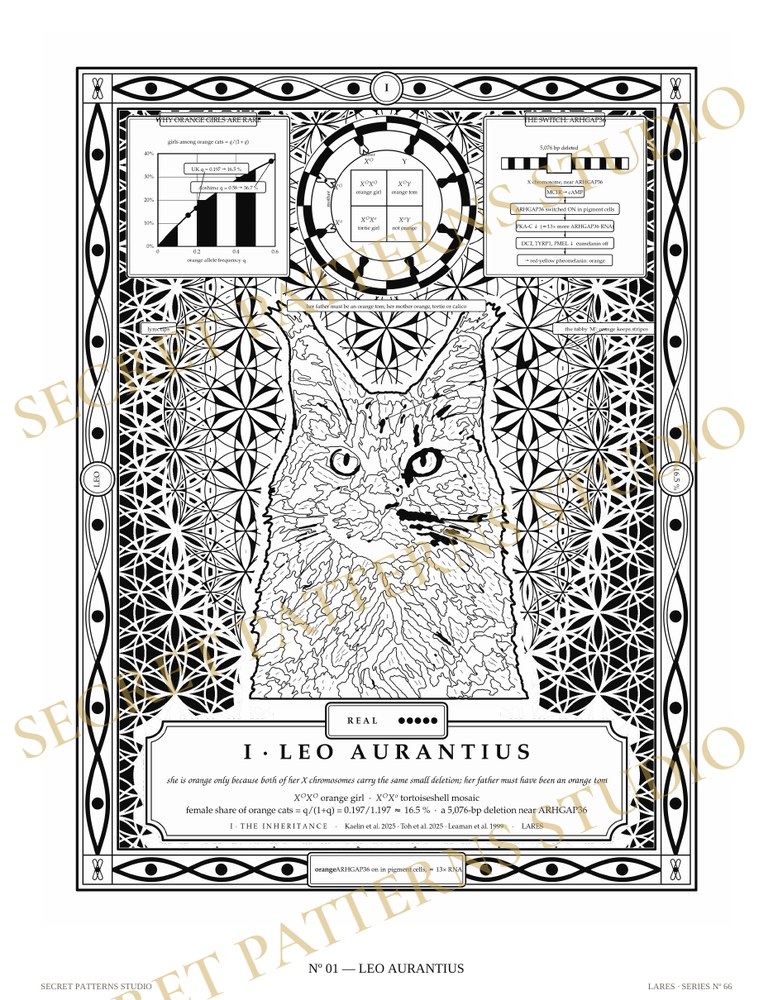
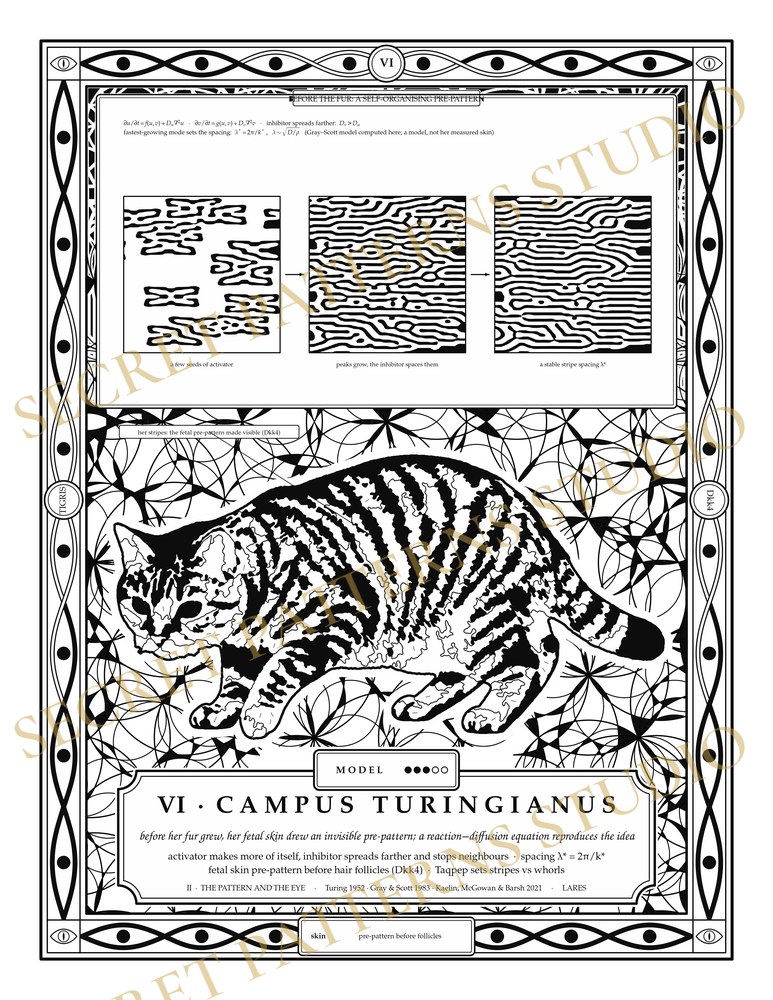
Coloring Book · $12
A coloring book with 25 full-resolution pages — a printable PDF, with the color cover.
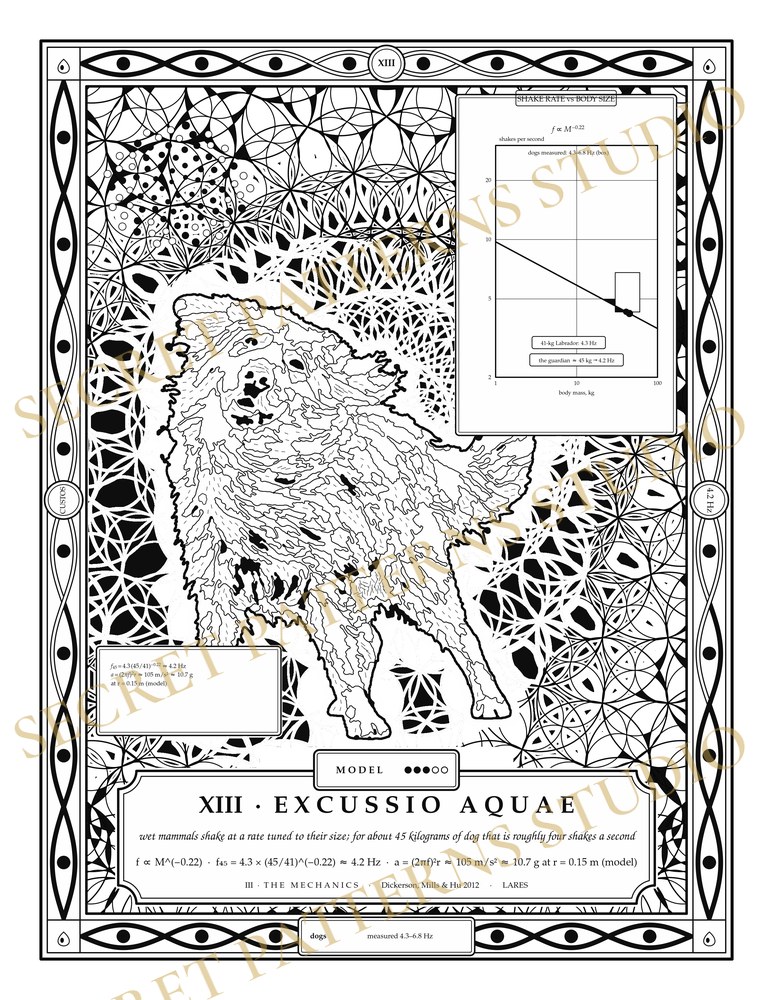
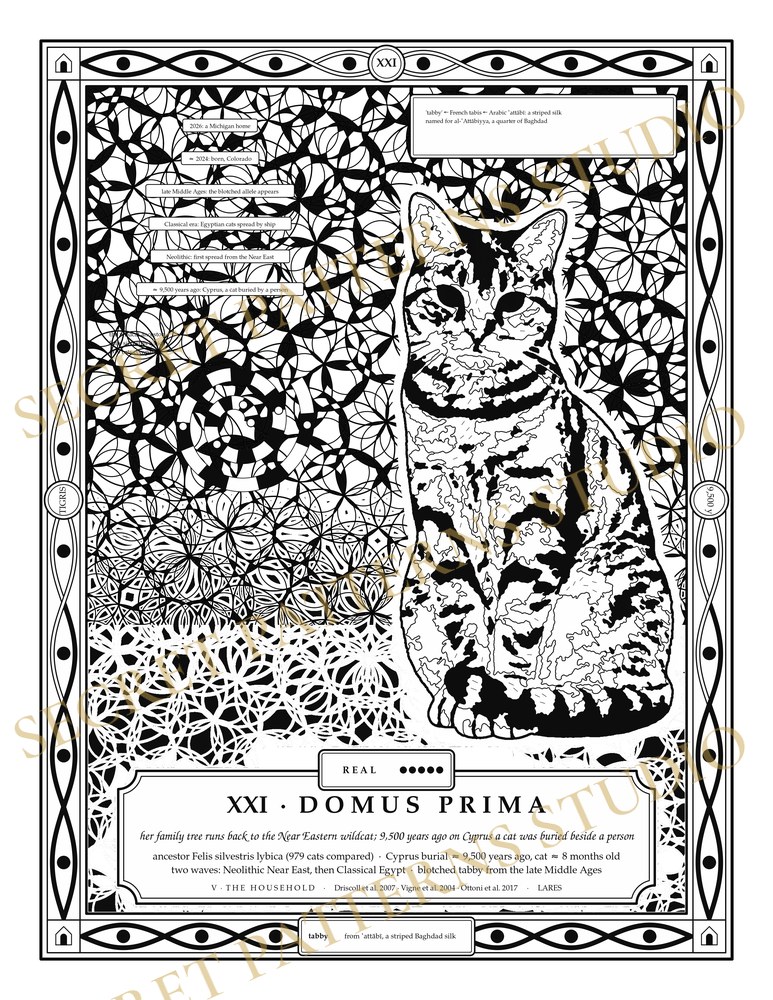
The coloring book of Series Nº 66 — LARES: twenty-five plates of one household — Leo, an orange Maine Coon; Tigris, a brown mackerel tabby; and Custos, a Great Pyrenees — in five movements — I · THE INHERITANCE, II · THE PATTERN AND THE EYE, III · THE MECHANICS, IV · THE WARMTH and V · THE HOUSEHOLD — each animal drawn from the science underneath it: the orange gene and the long coat, the tabby's Turing stripes and slit-pupil eye, the guardian's double dewclaws, tuned shake and methylation-clock age, and the house the three of them share. Three animals, one geometry. I · THE INHERITANCE — LEO AURANTIUS; VIRGATA AUT MACULATA; ALBUS NON VACUUS; VELLUS LONGUM; CALCAR DUPLEX. II · THE PATTERN AND THE EYE — CAMPUS TURINGIANUS; AURIS LYNCEA; PUPILLA FISSA; LABYRINTHUS ODORUM; TAPETUM LUCIDUM. III · THE MECHANICS — LAMBENDI COLUMNA; CASUS FELINUS; EXCUSSIO AQUAE; SALTUS; LINGUA CANINA. IV · THE WARMTH — MURMUR FELIS; VELLERIS CALOR; GLOBUS HIBERNUS; SOMNUS CUSTODIS; NICTATIO LENTA. V · THE HOUSEHOLD — DOMUS PRIMA; CRESCENS LEO; HOROLOGIUM CUSTODIS; FABULAE ET GENOMA; LARES. The honesty gloss travels: the genetics, optics and mechanics on these plates are the published science — the 2025 ARHGAP36 deletion behind orange coats, the Taqpep and Dkk4 work behind tabby patterns, the ZRS switch behind extra toes in both the dog and the Maine Coon — and where a plate works a figure instead of measuring it, the plate is marked MODEL or IDEALIZED and the figure is a worked estimate, never a measurement. No plate in this series is labeled anything stronger than its evidence. Cover, title page, all 25 plates with their titles, and a closing page — 28 pages, print-ready PDF. Colorability: 11,185 color regions across the 25 plates, every plate flood-fill checked with a smallest cell of 1.51 mm and a clean frame, about 79% of the colorable area in regions at least 2.5 mm across, and no single colorable field takes more than 27.8% of a plate's colorable area. Fine-work note: about 26% of the finest line in this series is very fine — the sacred-geometry grounds — so print at 100% and use gel pens and sharp pencils for the fine passages.
| Contents | 25 full-page coloring pages — twenty-five plates of one household (Leo, an orange Maine Coon; Tigris, a brown mackerel tabby; Custos, a Great Pyrenees), in five movements (I · THE INHERITANCE, II · THE PATTERN AND THE EYE, III · THE MECHANICS, IV · THE WARMTH and V · THE HOUSEHOLD): LEO AURANTIUS; VIRGATA AUT MACULATA; ALBUS NON VACUUS; VELLUS LONGUM; CALCAR DUPLEX; CAMPUS TURINGIANUS; AURIS LYNCEA; PUPILLA FISSA; LABYRINTHUS ODORUM; TAPETUM LUCIDUM; LAMBENDI COLUMNA; CASUS FELINUS; EXCUSSIO AQUAE; SALTUS; LINGUA CANINA; MURMUR FELIS; VELLERIS CALOR; GLOBUS HIBERNUS; SOMNUS CUSTODIS; NICTATIO LENTA; DOMUS PRIMA; CRESCENS LEO; HOROLOGIUM CUSTODIS; FABULAE ET GENOMA; LARES; every page is one of the artist's own plates, printed large on its own US Letter page, and the science is labeled plate by plate |
|---|---|
| Format | PDF — 28 pages (cover, title page, 25 plates, closing page), US Letter |
| Pages | 28 — cover, title page, 25 plate pages and a closing page |
| Page size | US Letter |
| Plates | 25 plates + cover, title & closing pages |
| Resolution | 300 dpi plates |
| Honest limits | The designs are art and scientific visualization built from the three animals' real biology — the orange-coat gene (a deletion beside ARHGAP36, found in 2025), the tabby's Dkk4 pre-pattern finished by a Turing field, the guardian's double dewclaws and tuned shake; figures marked MODEL or IDEALIZED on the plates are worked estimates, not measurements; 11,185 color regions across the 25 plates, every plate flood-fill checked with a smallest cell of 1.51 mm and a clean frame, about 79% of the colorable area in regions at least 2.5 mm across, no single colorable field over 27.8% of a plate's colorable area; fine-work note: about 26% of the finest line is very fine (the sacred-geometry grounds) |
| License | Personal, household use |
| Delivery | Download instantly after payment |
The coloring book of Series Nº 66 — LARES: twenty-five plates of one household — Leo, an orange Maine Coon; Tigris, a brown mackerel tabby; and Custos, a Great Pyrenees — in five movements — I · THE INHERITANCE, II · THE PATTERN AND THE EYE, III · THE MECHANICS, IV · THE WARMTH and V · THE HOUSEHOLD — each animal drawn from the science underneath it: the orange gene and the long coat, the tabby's Turing stripes and slit-pupil eye, the guardian's double dewclaws, tuned shake and methylation-clock age, and the house the three of them share. Three animals, one geometry.
I · THE INHERITANCE — LEO AURANTIUS; VIRGATA AUT MACULATA; ALBUS NON VACUUS; VELLUS LONGUM; CALCAR DUPLEX. II · THE PATTERN AND THE EYE — CAMPUS TURINGIANUS; AURIS LYNCEA; PUPILLA FISSA; LABYRINTHUS ODORUM; TAPETUM LUCIDUM. III · THE MECHANICS — LAMBENDI COLUMNA; CASUS FELINUS; EXCUSSIO AQUAE; SALTUS; LINGUA CANINA. IV · THE WARMTH — MURMUR FELIS; VELLERIS CALOR; GLOBUS HIBERNUS; SOMNUS CUSTODIS; NICTATIO LENTA. V · THE HOUSEHOLD — DOMUS PRIMA; CRESCENS LEO; HOROLOGIUM CUSTODIS; FABULAE ET GENOMA; LARES.
The honesty gloss travels: the genetics, optics and mechanics on these plates are the published science — the 2025 ARHGAP36 deletion behind orange coats, the Taqpep and Dkk4 work behind tabby patterns, the ZRS switch behind extra toes in both the dog and the Maine Coon — and where a plate works a figure instead of measuring it, the plate is marked MODEL or IDEALIZED and the figure is a worked estimate, never a measurement. No plate in this series is labeled anything stronger than its evidence.
Cover, title page, all 25 plates with their titles, and a closing page — 28 pages, print-ready PDF. Colorability: 11,185 color regions across the 25 plates, every plate flood-fill checked with a smallest cell of 1.51 mm and a clean frame, about 79% of the colorable area in regions at least 2.5 mm across, and no single colorable field takes more than 27.8% of a plate's colorable area. Fine-work note: about 26% of the finest line in this series is very fine — the sacred-geometry grounds — so print at 100% and use gel pens and sharp pencils for the fine passages.
Complete Series Pack · $15
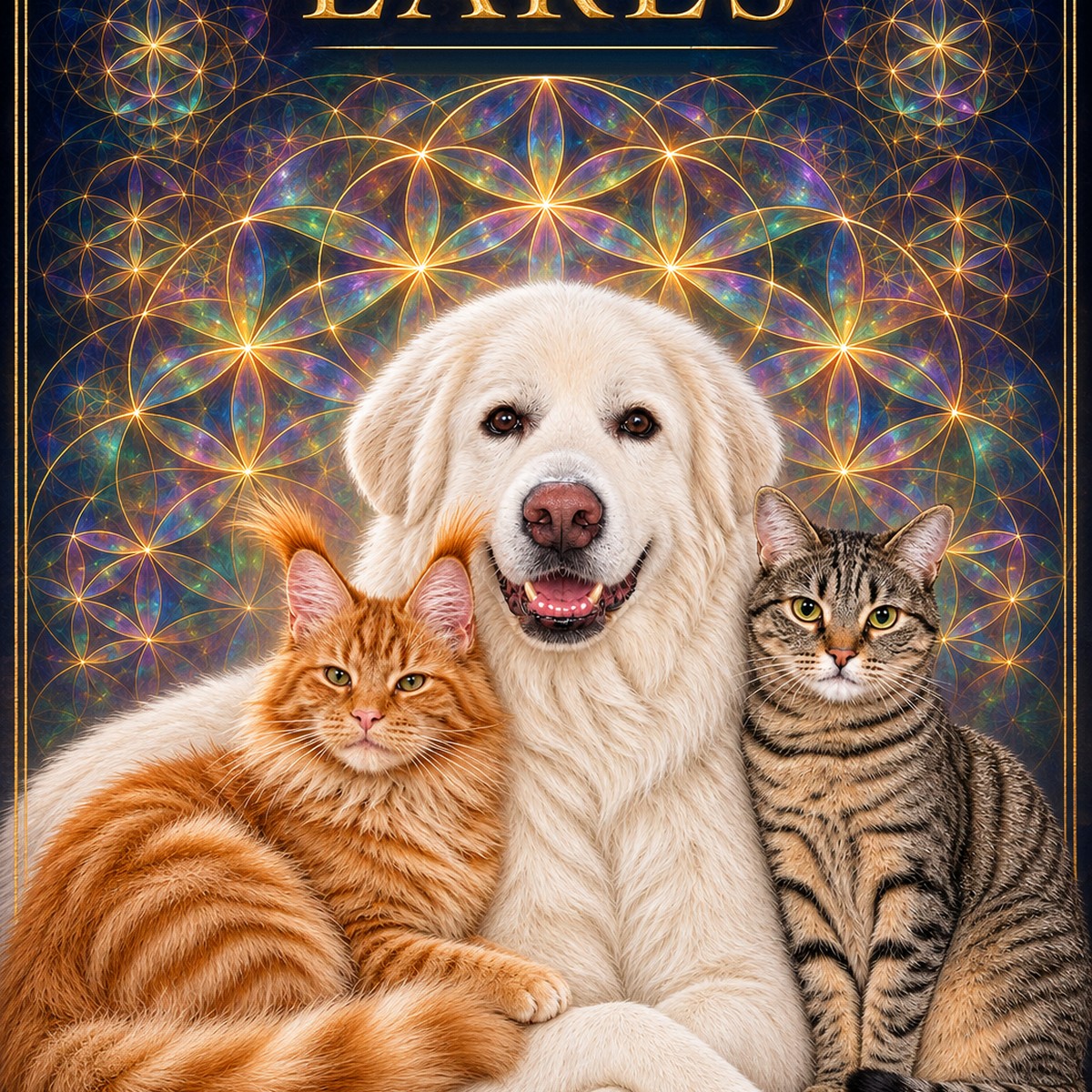
The complete series pack — all 25 plates at full resolution (PNG, 300 dpi), the printable plates PDF and the series color cover.
Series Nº 66 — LARES: Complete Series Pack. The masters edition: all 25 plate PNGs at full resolution (2550×3300, 300 dpi), the series color cover, and the printable plates PDF (cover + all 25 plates, print-ready) — plates, cover and printable plates PDF only. Twenty-five plates of one household — Leo, an orange Maine Coon; Tigris, a brown mackerel tabby; and Custos, a Great Pyrenees — drawn from the science of the three animals: the inheritance, the pattern and the eye, the mechanics, the warmth, and the household they share. The science is real and labeled plate by plate: the orange female's double rarity (an X-linked deletion beside ARHGAP36, found in 2025); the mackerel tabby's ancestral stripes — a Dkk4 pre-pattern finished by Turing reaction-diffusion; the white guardian's tuned shake, about four cycles a second at that size, and the backward-ladle tongue; the same ZRS switch behind the guardian's double dewclaws and the Maine Coon's extra toes. Figures marked MODEL or IDEALIZED on the plates are worked estimates, not measurements, and each plate says so. Fine-work note: about 26% of the finest line is very fine — the sacred-geometry grounds. Gel pens and sharp pencils suit the fine passages. Personal, household use. Instant download.
| Contents | All 25 plates of LARES (Series Nº 66) as full-resolution PNGs (2550 × 3300, 300 dpi), the series color cover, the printable plates PDF (cover + all 25 plates, ready to print) and a README |
|---|---|
| Format | ZIP — 26 PNG + 1 PDF + README (28 files) |
| Resolution | 2550 × 3300 · 300 dpi |
| Honest limits | The designs are art and scientific visualization built from the three animals' real biology — the orange-coat gene (a deletion beside ARHGAP36, found in 2025), the tabby's Dkk4 pre-pattern finished by a Turing field, the guardian's double dewclaws and tuned shake; figures marked MODEL or IDEALIZED on the plates are worked estimates, not measurements; 11,185 color regions across the 25 plates, every plate flood-fill checked with a smallest cell of 1.51 mm and a clean frame, about 79% of the colorable area in regions at least 2.5 mm across, no single colorable field over 27.8% of a plate's colorable area; fine-work note: about 26% of the finest line is very fine (the sacred-geometry grounds) |
| License | Personal, household use |
| Delivery | Download instantly after payment |
The masters edition of Series Nº 66 — LARES: the complete series exactly as drawn — all 25 plate PNGs at full resolution (2550×3300, 300 dpi), the series color cover, and the printable plates PDF (cover + all 25 plates, print-ready). Nothing else is in the pack: plates, cover and printable plates PDF, plus a README.
The science is labeled plate by plate: the orange female's double rarity is real genetics (an X-linked deletion beside ARHGAP36, found in 2025); the tabby's mackerel stripes are the ancestral wildcat pattern, pre-drawn by Dkk4 and finished by a Turing field; the guardian's white is a pigment decision, not an absence, and the double dewclaws share a switch with the Maine Coon's extra toes. Where a plate works a figure — a shake frequency, a tongue-ladle volume, an age on the methylation clock — the plate is marked MODEL or IDEALIZED and the figure is a worked estimate. These plates are art and scientific visualization, and they say which is which.
11,185 color regions, every plate flood-fill checked, smallest cell 1.51 mm — generous, closed regions throughout, with a fine-work note: about 26% of the finest line is very fine (the sacred-geometry grounds), so gel pens and sharp pencils suit the fine passages. Print the plates, color them on paper or in your app, frame them — personal, household use.